Showing posts with label recruiters. Show all posts

From Full-time To Freelance

Everybody wants a little more freedom to do/move/live/create as they please. That's a human truth that has been etched in stone since the day before the beginning of time. 

Finding the job that allows you even 75% of that freedom is golden. Having a boss/team/client/projects that push you to think outside of the usual confines of advertising/traditional ideals is golden-er. 

Also, having the environment where you can leave early sometimes or feel open/comfortable enough to play your guitar or wear flip flops around the office is golden and covered in diamonds. 

But not everyone can have that. So what is the best option to do/move/live what you want? Freelance. (I didn't add "create" in there as I did earlier because I feel like that's inconsistent. Sometimes you're called in just do resize stuff so the full-time creatives can create. And sometimes you're called in to work on a new digital campaign for the next project launch. It varies.) 

I thought this article was a good reference for aspiring and/or new freelancers.

Related Reading: 
Freelance VS Working for Free - How to decipher if this "favour" is really "freelance." (Also check out Life Hackers - When and If You Should Ever Work For Free.)
Freelance: A Starting Point - How to find freelance work.
Freelance Money Talk - How to determine your rate.
Freelance Etiquette - How not to be an asshole freelancer.
Freelance Tax Tips - Good to think about now so you have everything in order next April 15th. 
Freelancer Turned Full-Time - Interview with a junior freelancer who landed a full time gig. 

How Do I Become A Full-time Freelancer? 
via Bklynresumestudio.com

A client said to me yesterday, “So this is something you do on the side for extra income, right?” to which I replied, “Not at all – this is my full time job. I work 40/50 hours a week doing this.” And while I think that scored extra credibility points in his mind, I also got the impression he was surprised that someone could be making a full time living writing resumes. You can – a very good one. But it also took me 3+ years and many revised drafts of my business plan to get here. It’s important to not only be open to that cycle of change and evolution when you have a business, but to also expect it.
Some people have great success starting from day one, and for others it takes months, even years, to reach a point of financial sustainability.  And whether you plan to freelance and work as a contractor for other companies, or independently on your own with your own clients, planning is key.  But you CAN set yourself up for success before you even leave your 9-to-5, to ensure you’ll be on your way to turning profits and bringing in customers sooner than later:
  • Get clear on the 5Ws.  Know what you want to do, who you want to serve, why it’s of value to them, and when & where you will make it available. And then price it accordingly.
  • Practice telling people what you do. The more comfortable you become referring to yourself as your new title and explaining what you can do, the lesser the chance you’ll fumble it up in front of clients when it really matters.
  • Figure out what professional connections you already have that you can leverage for projects and work. Be careful of violating any non-compete policies if you’re remaining in the same line of work as your former employer. But do look at past clients, colleagues, supervisors, and other vendors you may have worked with who might be able to refer work to you or be a potential client themselves.
  • Tell everyone you know about your new venture. Don’t assume friends, family and colleagues don’t know people who can potentially use your services. My biggest revenue source to date, in revenue and in client volume, has been referrals.
  • Have a solid 12-month financial plan in place before you quit a full time job.While it’s great to be optimistic, it’s better to be realistic around the fact that new businesses take time to generate revenue. You don’t want to be building your business from a place of desperation.
  • Update your LinkedIn profile and all of your social media profiles. Even if you’re not billing hours right away, that does’t mean you’re not a serious practitioner of your craft. Get the word out, because that’s the only way the money will come.
  • Create a business plan. Even if you don’t think you need one, you need something to guide your financial planning, decisions around product development, understand the competitive landscape, and plot out your target audience. And as your business evolves, so too will your business plan, and putting long and short-term goals in place will help you track and get a better sense of what’s working, and what’s not. Referral business is free. $300 per month worth of ineffective Google advertising isn’t.
  • And finally, put a timeline in place and choose a date to kickoff your transition. Whether it’s the day you plan to give your notice, officially launch your business, or be working completely on your own, it’s much easier to set a specific date and work backwards toward your goal, then to sit around and wait for the right opportunity and timing.  Having a deadline-based goal for making a transition will help you plan much more effectively from a financial and personal perspective, and you’re more likely to stick to it if you have it in front of you visually."

Don't Accept That Offer. Yet.

I know you've been looking for a while now. I know you're tired of writing and revising emails,
working and reworking your book and waiting waiting waiting for a Yes.

And it'll come.

Just don't jump into it blindly.

That first job offer is magical. It's like chocolate-covered rainbows dipped in angel dust.

And it's easy to get caught up in the excitement and jump on it.

Don't.

Here are a few things to consider before you accept that offer

1. Do you want to work there? With these people? On this client? For 40+ hours a week, 50ish weeks a year? Being miserable at a job is slow death. Make sure it feels right in your heart first.

2. Make sure it feels right for your pocket. Really look and see if you can afford to eat, sleep somewhere and pay your bills with the salary they offer. You probably had that conversation earlier in the interview process, and probably pulled a figure out of your ass when the recruiter asked what you think about salary. So take some time right now and check salary.com and talentzoo.com and look at your budget and come up with a range that is appropriate for your position and life.

3. Research the agency (you should've done this before you even sent them your book). What's the culture? What's their reputation? What do other people say about them? What is their standing with clients - you don't want to get hired and they lose an account and you lose a job.

4. What do you want to gain from being here? Whether you end up being there for two years or twenty, go into it with a plan of what you want to do, learn and put in your book. Think about what your next step in your career and make sure this job will help you get there.

Honestly this is a big decision that requires a lot of time and thought.

If all of this aligns and is right, then please, go right ahead and sign that paper and then take a nice long soak in a tub full of Doritos.


Job Hunt Tips & Mistakes

Here's an interview with a creative recruiter that discusses Dos and Don'ts for your job search. Just in case you didn't believe a word I've been saying for the past 300ish posts...*ahem*... now you can hear it straight from the horse's mouth. And I can hold up Kanye's "I told you so" sign. (After I borrow that jacket.)


Stuff I Told You That's Reinforced in the Interview:
You must have a portfolio.
You need to have big ideas (conceptual campaigns that carry across different media with various executions.) 
An awesome portfolio trumps just about everything.
Internships help you know what kind of working environment you work best in and automatically puts you in the hiring pool for future positions. 
Be excited when a recruiter contacts you – but you have 3-4 rounds of meetings with different people and approvals to go through before you get hired – so don’t quit your retail job just yet.
Put your real name and contact info on everything.
Always include a link to your portfolio in emails etc.
Keep emails concise and focused.
Get on LinkedIn.
Have possible partners in mind just in case they’re looking for a team.
Network, network, network.
Ask questions.
Don’t be a pest.
Don’t look down on internships or freelance.
Learn about the agency you’re interviewing at.
Don’t copy and paste the same email over and over.


The Interview:
from Miami Ad School's blog

Recently we caught up with Alexis Gianoulis, Global Creative Talent Coordinator for Y&R in New York. She visited Miami Ad School South Beach to review portfolios and help students who are getting ready to graduate with interview skills and tips for their books. We spoke to her to get some insight into what she looks for when hiring and how students should prepare as they get ready to interview and look for a job. In today’s post, she talks about the importance of a portfolio and the educational background and experience of an applicant.

What do you look for in a portfolio and why is building one so important?
I look for big ideas! As a recruiter it's impossible to consider a candidate without a portfolio to show his or her work. Junior level positions and even internships are very competitive so it's a requirement for all aspiring copywriters and art directors. Today it's equally as important to have a portfolio available online.

Do you take into consideration the educational background and experience of a potential hire or is it more about the portfolio?
An awesome portfolio will always trump educational background and past experience; however,  it's something to take into consideration. It also depends on what type of job I have available. Sometimes the role dictates that the candidate has a specific skill set or prior experience. For example, I often get requests for art directors with a background in graphic design. As a global recruiter, sometimes I also get requests for candidates that can speak certain languages so that's another example.

Are internships important?
Yes, I think internships are extremely important for both the candidate and the employer. As a student it's difficult to know what type of environment you want to work in once you graduate (large agency vs. small agency, having mentorship vs. autonomy, working across accounts vs. being siloed, working in a major market vs. a smaller one, etc.). If you don't do an internship in a real-world setting, it'll make your job search that much harder. For the employer, it's a bonus to meet a junior candidate that's decisive in their goals. Also, doing an internship is a great way to get your foot in the door with an agency. Typically, we look to our past interns as potential hires when we have job openings.

Once a creative recruiter sees a candidates book and likes them what happens? Recruiter contacts the candidate by email or phone to discuss the opportunity and learn more about them personally. The recruiter might then send their portfolio to the Creative Services Director or a Creative Director for their opinion and feedback. Assuming everyone is still interested, the candidate is brought in to meet with the recruiter in person. Then, the candidate will be brought in again to meet with other members of the creative team (people they would be working with or working under). Final decisions are then made about hiring.

What tips would you give junior creatives who are looking for their first job? • Always include your contact information (email and phone number) on your personal website/portfolio. Include your real name somewhere on your portfolio. I often see a team name, nickname, stage name, etc. but that's not helpful when I'm trying to contact you. • If emailing a recruiter, make sure to send a link to your portfolio in the email. Otherwise, we probably won't go through the trouble of figuring it out. Keep emails short and sweet with a clear message about what you want. Most recruiters won’t take the time to read something that looks like an essay. • Get on LinkedIn. Do it now! Make sure your website/portfolio is available through LinkedIn. • Have a partner in mind even if it's someone you're willing to work independently from. At the junior level we most often hire in teams. • Take this time to network with as many people in the industry as possible! Don't be afraid to set up informational interviews/casual meetings and ask lots of questions.

What are the biggest mistakes you see juniors make? Not following the above tips, harassing recruiters for jobs, thinking you're too cool for school (not willing to consider a paid internship or freelance gig if a full-time job isn't available), not knowing anything about the agency you're interviewing with (recent work, top creative leaders working in the agency), and copy and pasting the same email message to multiple people in the same agency (we will know). I'm sure there are more mistakes but these were the first that came to mind.

Common Portfolio Review Mistakes

Love this post on Dear Brook (a blog for juniors written by a junior) that covers 5 common mistakes creative wannabes make at portfolio reviews.

I definitely have seen all of these in action and have actually stopped a review to give similar advice.

Are you guilty of any of these?


5 common mistakes Juniors should NOT make

28130424
Last week, I attended "Where are all the black people" event  and while there were some amazing panels about diversity and young creatives in advertising, I got to review tons of Juniors' portfolios and I met some amazing people in the process. For a while I was the person getting their portfolio reviewed (and still am actually) but for one day I got to see what it's like to be on the other side of the table. First of all, I applaud all the young creatives who were so enthusiastic and received constructive criticism so gracefully; I know it's hard, but you guys are on the right track I promise! One more push and you'll be enjoying nights and weekends at your new agency :D

During the event, I also got to see the common mistakes Juniors make while getting interviewed and presenting their work. A couple of months ago, I wrote a post about networking, which you can revisit. In case you don't know yet, networking is very important and apparently, it's an Art.
Now back to those common mistakes. They are common because A LOT of people make them, don't be one of them. Ask yourself honestly if you make any of the following 5 common mistakes:

1- Eye Contact
Man, that is the worst one for me. If you're sitting in front of someone who took the time off their busy day to come meet with you and help you in your career, the least you can do is PAY ATTENTION when they talk. I understand that a lot of young peeps are ADD, I'm ADD! But come on, show some respect and look at them in the eye. I can't stress it enough, it is such a turn off. This actually happened to me during the event, and for some reason I remember the guy with the wandering eyes very well. Now, that's not how you want people to remember you, do you? F-O-C-U-S

2- Overconfidence
Juniors who think they are the S#*t, yep they exist. A Junior by definition is someone who is starting, who is a beginner hence they don't know S#*t. Being confident is great, being overconfident is simply annoying. Here's the thing, when you're overconfident, you automatically think you know it all, and when you think you know it all you don't have an open mind, when you don't have an open mind, you don't learn anything and when you don't learn anything, you stay a Junior who doesn't know S#*t. Nice little picture I drew for you there huh? Be confident but stay humble.
ADDED BY @THEDAWE: Arrogance is a big one. If you're great, don't worry, you'll have plenty of opportunity to show it, not preach it. 

3- Lack of practice
When you go interviewing, you really have to practice your elevator pitch. You gotta know what to say, when to stop and listen and how to answer questions. I had people sit down and hand me their portfolios and wait for feedback. BOOORRRINNNG! I'm already not interested in your work. When you come to interview or show your folio, you have to be ready to speak, show your personality and walk them through your work. People are not going to understand the thinking behind your work unless you tell it. Think of it as storytelling. Go in there, talk about yourself, how you got to where you are, say an anecdote or two, tell them about your work and walk them through it. DON'T EXPLAIN YOUR WORK, just walk them through it. Then ask for feedback, take notes, exchange business cards, thank them for their time and ask if you can connect in LinkedIn later. Then follow up with a written card.
Practice is crucial Juniors, the more you practice, the more you feel confident and the more they'll like you. I talked to some international students–and while I understand that language can be an issue because english is not my first language so I'm on the same boat– It's really hard to communicate with someone you don't understand. So my advice to you guys is to speak loud enough to hear and really practice what you're going to say 100 times. We're in the business of communication and if you can't communicate properly, it will be an issue.

4- Portfolio format
I was SO surprised by the amount of people who brought an actual printed portfolio. I thought those things were long gone? I guess I was wrong. I think 80% of the people I met with had a printed portfolio. Some people will say that there's nothing wrong with a printed portfolio but I disagree. I think a digital portfolio is the way to go. Unless you have some amazing printed art or designs or letterpress or something like that, then go digital. It's cheaper, easier to manage and you don't have to carry it around! Speaking of digital, I was also surprised by the amount of juniors who had only print pieces in their books. Some of them are great ideas that can easily be expanded into digital pieces. My advice to all of you is: Think Campaigns. Show the way you think, explore new and untapped mediums, go all out. Don't do what agencies are doing now, do something different that no one has thought about yet. it's easier said than done, I know. But give it a try.

5- Lack of focus 
I understand that sometimes Juniors don't know what they want, they are not sure if they're creative or account or media etc. BUT! when you apply for a job and go for an interview, make sure you don't come off as "Mr know it all" or "Miss I have no clue what I want". I guarantee you won't get a job like that. There are many articles, books, blogs about advertising, it's not that hard to learn about the different departments. Before you go to an interview, make up your mind. Learn as much as you can about the position you're applying for and see if that's something you want to do, if the answer is no, then don't apply. It's a waste of your time and the agency's time. If you need help or advice, seek mentors, ask questions before you start intervewing, that's what I'm here for. On the other hand, don't act like you know it all (Read 2- Overconfidence above). One guys was like, yes I'm a creative, but i can do startegy and consider myself a producer... i was like, dude, pick one, you just listed 3 departments. Don't be that guy. If you can't choose, try to get an internship where they'll let you intern in different departments. You'll eventually find what you want to do.
Overall, I had a blast at the event and I met some really talented people. My last advice to you all is to be fierce. Go get them. Speak up, don't be shy. Go after what you want because if you sit there and wait, it'll never come to you.

Love,
Brook

What Makes a Great Creative Director

 When looking for a job, don't just look at the agency, look at the clients and most importantly, look at the team.

Check out the culture of the team. Walk around the floor. See the work spaces. Talk to the people - not just the ones with big titles. And talk to the creative director.

Are these people you want to work with til 11pm? People you want to learn from? People you want to hang out with at work events?

Is the creative director someone you respect, who you think you can grow under? 

I had a creative director who wouldn't even blink at my Good Mornings or speak in my direction. I didn't feel like I was part of the team or like he cared if I was happy, overwhelmed or growing. That, along with other factors, made me hate going to work.

You may feel a little desperate because you really, really want a job and just want to get in there and start working (I'll admit, it's easier to get a job once you already have a job.) But don't let the allure of being employed or the name on the side of a building make you jump into a bad situation.

Check out this article from Anne Hubben that examines what makes a great creative director.

What Makes a Great Creative Director
Posted on 10/11/2012 By Anne

I’m working with someone who is stepping in to the role of Creative Director and we’ve been talking  about what makes a Creative Director great. I found a few excellent articles that have already been written (links below) and tried not to duplicate, but there are a few points that I hear repeatedly and will mention here as well.


To be a great creative director, you must:

Have great work in your portfolio
:  Creatives respect exceptional work from other creatives, especially the person leading them. You can walk in to a room and have the presence of a leader where you look the part and speak the part, but if your book doesn’t show smart, creative work, then you’ll have some challenges.

Continue to do great creative work:  You also can’t rest on your laurels. Having won an award 10 years ago for a recognizable campaign is admirable, but you’re going to have to have strong recent work too. What have the teams you’ve led produced lately?  Do you roll up your sleeves and work along side your team when necessary?  When nobody can crack a creative brief and it’s getting down to the wire, are you able to throw out something that the team can use?

Be a thought leader:  You have experience, opinions and a vision that you share with your team on a regular basis. Your team knows what the vision is and can articulate it and/or show it in their work. If they don’t get it yet, they’re not afraid to ask because you don’t take it personally, but instead see it as your responsibility to communicate more effectively.

Be able to separate the good ideas from the crap:  That’s pretty self-explanatory.  You believe in your team’s ability to make the work better. You have the willingness and desire to improve their work. When there’s someone that’s not performing as they should, and you’ve worked with them, given them direction and they’re just not getting it, it’s time to let them go. But they shouldn’t be surprised by it (that’s a whole other post).

Be specific with feedback:  So many creative directors think it’s okay to just say “it’s not there yet” and send the team away. But, how do creatives work with that?  They beat their heads against the wall, that’s how. They need specific feedback, direction, suggestions. As a great creative director, you know how to get the best work out of your team and you give them the tools to get there.

Stay connected to your people: You know your team as individuals. You know what motivates each of them. As many have discovered, you can’t motivate a 23-year old and a 42-year old in the same way. There’s no “right” way either. They’ve grown up differently and as a result, they learn differently, are motivated differently and work differently. It’s your job to get to know them and determine how to effectively communicate with them.

Be a great communicator:  With your team, your account people, your bosses and clients. There’s also a misconception that you have to be an extrovert to be a great communicator. I disagree. We all know those people that say more with fewer words.  Don’t let the flamboyant extroverts keep you from striving for the Chief Creative role.

Stand up for your creative team’s work:  No creative wants to feel like an order taker. Nor do they want to feel that their leader will crumble under pressure.  As a leader you should have your people’s back.

Have humility:  You’ve received plenty of accolades, have done award winning work, now it’s time to let your team shine.  Also, don’t be afraid to admit when you’ve made a mistake, own up to it and learn and teach from it.

Give credit and/or take the blame:   You work on boosting other people and help them rise up and be their best.  On the flip side, your people are going to make mistakes. As a great creative director you don’t throw your people under the bus.

Be able to spot and nurture talent:  As a recruiter I had to put this in. I’ve worked with some creative directors who were able to see talent where others might not. They don’t expect to see exactly what the job description says. They value people from all different backgrounds — screenwriters/fine artists/illustrators or they have that background themselves. Variety makes people interesting. I always encourage people who aren’t working to find a personal project to pursue. It keeps you engaged and makes you interesting to people who are hiring while also keeping you happy and sane.

Never stop learning:  It has always been important for creative people to continue learning, to stay up on trends, ideas, art, pop culture, politics, global issues, life in general. But now more than ever, it’s critical to embrace technology so you can stay on top of that too.  You don’t have to know how to do it all, but play around with technology, check out sites you hear about, download apps, get an iPad, see what Twitter’s all about. If you don’t “get it” watch someone who does, or ask them about it. It’s fun if you open up to it and if you want to be great, you have to be open.

That’s my list for now. I got some great suggestions from people after posting the question of what makes a creative director on my social networks, so thank you to all of you who answered.


Mailbag: Responses from a recruiter

Came across this post on Confessions of a Creative Recruiter and thought these answers would be helpful to you. Yes, you.


Q: When is the best time of the year to apply for jobs as a copywriter?
At first, I didn't really think there was a season for copywriter jobs, but when I thought again about your question I changed my mind. I can tell you the season when agencies and recruiters are flooded with other candidates - graduation time. This may not translate to a hiring season, but it certainly would be the time when you are competing against a larger than average pool of candidates.
I wrote a post a while back about two seniors about 2 months from graduation and they were already making their rounds across the country on informational interviews. They wanted to beat the graduation rush and that was pretty smart.

Q: Do you have any advice for a copywriter trying to get a job without a partner?
Have a great book. That's it. The best books get the job, partner or not.

Q: Does your level of creativity determine salary and/or title?
Not title. Right out of school you are a junior until you prove yourself otherwise. (I am assuming you mean juniors here). Now salary, perhaps a bit. If I think a person is super, super good and that they may be considering other opportunities, then of course I want to entice them with a higher salary. We just interviewed Jeremy Carson, an CSULB senior three days before his graduation. His book was fantastic. Right now he has more than one employer courting him and I can bet you the highest salary has the strongest chance of landing him.

Q: Do all ‘juniors’ have to start as juniors?
Uh. Yea. But that you put 'juniors' in quotes I am guessing you mean someone who maybe is older than the average student or had another career before getting in to advertising, then are they really a junior when they start? I met a guy at Brandcenter recently who went to portfolio school, became a copywriter then went back to school to get his masters as a Creative Technologist. He asked me the same question. He isn't a junior due to his previous years in the business, but he is a junior in terms of just graduating with a different degree.
I would image each recruiter has the discretion to make the hire at whatever level seems appropriate. I'd hire that CT from Brandcenter as a mid-level person, his experience as an agency copywriter would be a big plus.

Q: How long should I wait for a response before realizing that they are just not into my book?
Well, always remember that no response does not necessarily mean they aren't liking your book. It usually means the person is way too busy with way too many books to look at to either check yours out or to get back to you once they do. Wait a decent amount of time after sending it before following up. Then wait a decent amount of time after that before sending one last communication (email/vm) that says something like, "I recently sent you my portfolio, which I am hoping you've had a chance to review. I am very interested in working at ________________, yet above all I'd love to hear your feedback on my work. May I get a few pointers from your perspective that would make my book better?
No person in their right mind could ignore that. A genuine request for feedback. Then, in getting their feedback, you'll also get a clearer answer if they like your book. Or not.

Q: Should we try to get the Creative Recruiters direct email, or just send via the 'general way', like whatever their website provides us with?
Try to get the creative manager's direct email. My HR forwards me anything remotely creative, but you don't want to take the chance that other HR people don't or that your email gets lost in the shuffle.

Reality Check: I don't remember you.

However, I will smile and laugh with you and pretend like I do until I remember or someone else comes by and helps me out.

Nothing against you in particular, it just happens sometimes.

Yes, we met before. We probably chatted and we may have exchanged business cards and a joke or two, however, I don't remember your name, or anything about you to be honest.

And I'm just me. I don't meet that many people. But imagine a creative director or a recruiter. Imagine how many emails they must get in a day. How many business cards they hand out. How many short conversations they have between here and there. It adds up and it's hard to keep track of every face, name and story.

This is why you have to stand out (I wrote about this here) and you cannot be afraid to remind people who you are.

In emails: Refresh their memory on when and where you met, maybe even give a reference to what you talked about to recreate the context and then state your business.

You don't have to attach photos or anything, just keep it simple: "Hey, I'm Julie, we met at the Nerdfest last Tuesday, I was wearing hot pink glasses."

In person: Don't be afraid to reintroduce yourself. Having a convo with someone who doesn't remember you is a waste of your time. Going through who you are a second time will help reenforce the information and hopefully they'll remember this time.

Don't act annoyed that they don't remember or try to hard to job their memory. Just start anew and try to do a better job of standing out. 

On LinkedIn: Always include a note with your invitation to connect. Say who you are and where you know them from.

I HATE getting messages that someone indicated that we're colleagues or friends when I have no idea who they are. (Lies! All lies!) I used to decline automatically (stranger danger) but I've started writing back and asking who they are, hoping it'd prompt people to realise we're not on Twitter, this is the grown up league.

Don't take the forgetfulness personally. And maybe it'll work to your advantage - consider it a second chance to leave a great impression. 

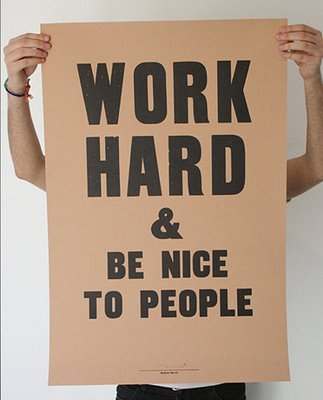
People to always be nice to:


Everyone.

Seriously.

Even the people you don't like. Even the ones who aren't nice to you.

You're going to meet these people again at another agency or at an industry event and you don't know who they could introduce you to, what job openings they may know about or when someone is going to ask them about you. (See Friday's post with advice on the Six Degrees of Separation in Advertising from a long-time creative recruiter.)

Who you know is just as important as what you know.

And they may not be the big fish now or be at the big name agency, but you'd be surprised where they end up (and where they can subsequently help you get.)

My old boss's boss started off as a creative assistant. Now he's a CCO.

Here's a list of people to always be extra kind to

* Receptionists (Get on their good side and they'll put your calls through, set up meetings for you, and tell you who you need to meet and maybe even introduce you.)

* Creative assistants. (Similar to receptionist. And he/she may help you with expenses!)

* Your counterparts. Even the lazy, douchey ones. (You'd be surprised how many informal reference checks happen)

* Recruiters. They remember. And they move around. So if they like you when they’re at Mediocre Agency Y, they’ll still like you when they’re at Amazing Agency X.

The connections you make follow you everywhere in this business. So do the connections you break.

Advertising karma is no joke. *Cue eerie music and light flicker*

Lessons from other blogs: You're Kevin Bacon

Six Degrees of Separation is no joke in advertising.
Everybody knows everybody else.
And everybody knows somebody that knows you - or somebody that you want to know.  

No joke, this happens all the time! Once, I was sitting with a coworker in NY discussing our weekends only to find out his friend Rodney from Atlanta was my friend Rodney from Atlanta. (Good thing I didn't say anything bad about him. lol.) Another time, an ACD that was awful to me emailed me years later asking me to introduce her to my ECD. Yeah. Right.

This is why it's important to manage your reputation, be amazing at work, connect with people and not be an asshole. 

If you don't believe me, read Cecilia Gorman's post (see below).  Cecilia is a creative recruiter and advocate for juniors (previously featured in Recruiter Loves & Hates). Her blog Confessions of a Creative Recruiter is pretty much what Baby Food For Creatives would be when (if) it grows up. She has great advice, examples and input for all aspects of your creative life.

Here is a post of hers I absolutely love on the six degrees of separation in advertising.

Coming Around and Going Around

In our industry it is a well-known rule, every person you cross paths with once, you'll cross paths with again. The sooner you learn this, believe this and act on this, the better.

First learn this. Learn that every person comes into your career for a reason. That co-worker you kinda can't stand. That creative director who is uber-ridiculously-detail-obsessed. That sweet receptionist who offered you a glass of water while you were waiting.

It's no accident that particular person crossed your path at that exact moment in time. Now your job is to treat them with respect (even if it is merely respecting their ability to be a jerk) and respond always with professionalism and kindness. You are building bridges early on in your career, it's much too early to tear any down.

Next believe this. Believe that any encounter with someone teaches you something. That ucky co-worker teaches you how to interact with difficult people. That polite receptionist teaches you that courtesy is title neutral.

Believe that you are going to spend your entire career meeting and mixing people who'll range from sweet as pie to big fat ugh. They teach you how to be a better person, a better creative, a better manager, a better whatever. You don't learn all this work stuff on your own. You learn it by having experiences (the harder, the better) with others. Those experiences are what help you grow in your career.

Lastly, act on this. Act like the person you've crossed paths with will be back in your life 10 years later. Because, in this industry, that's a given. Act like you would if, in 10 years, this person will be your boss. Or your HR director. Or your partner. I guarantee if you use this mentality, you'll always come out ahead.

Everyone remembers kindness and respect. Just don't ever, ever, ever forget that people remember disrespect and bad encounters even longer.
                                                                  --- 

Follow Cecilia
Twitter @adschooladvisor

Must Read: Breaking In Book

by William Burks Spencer

Guard your fingers my loves! 

Behold! A book. With words. And pages. And paper. And, thus, paper cuts.

And an amazing amount of information about creating a portfolio that will get you hired -- with interviews from big name creative directors that you want to hire you at big name agencies that you want to work at.

I present to you:


Ari Merkin (oops, I dropped something. A name.) recommended the site for this book when I reached out to him for tips for my Recruiter Loves + Hates post. He basically said: been there, done, that, here's the link. 

I don't know this William author/copywriter character, but this Breaking In Book is right on par with my mission: Helping you be a better creative. It's jam-packed with tips, dos, don'ts and straight horse's mouth talk on every page. Therefore, it has received the first ever Official Baby Food For Creatives Stamp of Approval. (It's not so much a stamp as much as it is sticky fingerprints on the front cover. But potayto potahto.)


Comment on this post and tell me why you need Breaking In the most and I'll mail you a copy.
For free. No strings attached. (Though all karma rules apply.)
 

Interview: Things Recruiters Love + Hate


Nothing beats hearing it from the horse's mouth.  Five recruiters and headhunters share some of the things you do in emails that they love and hate.


LOVE:

E-mails that clearly feature your title, level, current gig, link, referral (if applicable), and whether you're into freelance, full-time, or both, and your breadth of experience. – Kati

When you inject a dose of personality into your email. So I can get a feel for who you are as a person. – Cecilia

Tell me how you came across my name: did someone refer you to me, Linked In, Twitter, etc.?  - Laura

Always make sure to leave full contact information including all links to portfolios. – Kimberly

Simplicity of navigating sites – Lori

When they send me a follow up link with updated work 6 months to a year later. I may not have had a job then, but I might in the future. – Cecilia

HATE:

When you ramble. 6 paragraphs are 4 too many. – Cecelia

Unfinished portfolios: if you can't coordinate your own book, my agency will have a difficult time hiring you and I will have a hard time placing you.  – Laura

Long-winded explanations of each piece of work. – Lori

There is nothing worse than a glaring typo. Check everything (spec copy, name of the person you're emailing, company names, etc). Typos are a reflection of your own attention to detail.  – Kimberly

People who are lazy email communicators, who type 'r' instead of 'are,' 'ur' for you're & your.  Please email me like I am a colleague, not your drinking buddy.  – Laura

Overkill on the follow-up; recruiters can definitely use follow-up e-mails, but please give us a couple days to respond before trying again. – Kati

There you have it. Be nice, be concise, be buttoned up and be patient.

See more email tips The Art of Emailing and Email Dos & Don'ts

Happy emailing!


Special thanks to my wonderful and informative interviewees:
Cecilia Gormam: VP, Director of Creative Services, Y&R/Wunderman Irvine & Owner, Creative Career Management 
Kati Llewellyn: Associate Creative Recruiter, Draftfcb Chicago
Kimberly Easley: VP, Director of Creative Resources/Recruiting, Publicis Modem NY
Laura Bonetti: Creative Recruiter, Kay & Black NY